
Mulholland Drive feels like a fever dream of a woman in patriarchy, dreaming in its own structure. Lynch doesn’t simply show Hollywood, like so many filmmakers before him; he shows how Hollywood makes us think, how it creates in our consciousness: how it imagines, consumes, and also destroys women. I’ve seen this film many times, and each time it makes me think about whether female subjectivity is ever even possible in this machine – the so-called „dream factory“.
When I watch this film, I don’t try to understand every symbol, as some passionate Lynch fans do. The director himself took this search for the ultimate decoding of the film to the extreme when, in a post he wrote himself, viewers should try to keep track of the number of lampshades. I won’t try to decipher the actual plot or to separate dream from reality, as many viewers do.
First of all, I see him as a woman, as a socialist, a radical feminist and as a lesbian.
LA as nightmare landscape
In Mulholland Drive, Hollywood does not appear as a geographical site of production but as an epistemological structure that organizes visibility, power, and desire according to patriarchal logic. It is less a film industry than an ideological mechanism that transforms every gesture of creativity into a mode of submission. The city is represented as simultaneously alluring and disorienting, a visual dialectic between mobility and constraint, desire and surveillance. Roads twist through fog-shrouded mountains, freeways spiral into tunnels, and neighborhoods fold upon themselves, producing a topology in which linear navigation is impossible. This labyrinthine quality mirrors the contradictions of late capitalist cultural production: potential and opportunity exist only within pre-defined circuits of control and exclusion.
The architecture of domestic space extends this logic. Dianne’s apartment, with its circular staircases, looping corridors, and interior angles that suggest continuity without exit, exemplifies the way the material environment enforces both psychological and structural containment. The circularity of the space produces a visual and affective experience of being trapped within the conditions one ostensibly inhabits voluntarily, echoing the broader constraints of the film industry and the urban economy. Every doorway, hallway, and alcove functions simultaneously as access and barrier, reflecting the dual nature of the city itself, which offers routes toward desire and achievement while reproducing forms of subordination and dependency.
The Winkie’s Diner at night introduces another spatial modality: the urban underbelly. Fluorescent lights, long shadows, and deep perspective lines construct a space of unease. Here, the city’s class relations and social hierarchies become palpable: the diner functions as a microcosm of the city.
In Club Silencio the stage is both illuminated and hollow, the performers exist as simulacra, and the audience’s position is destabilized. Shadows and spotlights fracture perception, and the architecture produces a sense of dislocation: walls and curtains suggest depth, yet they are permeable, and every visual cue points to the instability of reality. This visual destabilization externalizes the structural dynamics of illusion and control: the spectators’ gaze is guided, and the very act of looking is conditioned by the organization of space.
The city’s spatial segregation further amplifies its nightmarish quality. Gated communities, enclosed residential blocks, and isolated commercial zones fragment Los Angeles into discrete, self-contained social units. The arrangement of apartment complexes and housing developments in circular or concentric patterns mirrors Dianne’s own apartment, reinforcing the thematic resonance between private and urban space. These enclosures create the illusion of safety and exclusivity while simultaneously reproducing social hierarchies and isolation. Inhabitants are enclosed within their own domains, yet constantly surveilled by structural and social forces beyond their control. The city becomes a network of discrete islands, each promising opportunity but delivering constraint, a geography in which social mobility is spatially and economically circumscribed.
Within this logic of fragmentation and enclosure, Los Angeles functions as a material and ideological nightmare. Its visual and spatial density the looping apartments, fog-shrouded freeways, gated hills, and concentric housing blocks produces a sense of endless repetition, disorientation, and containment. Desire, aspiration, and creative potential are perpetually mediated by structural hierarchies and spatialized power, while every moment of agency is circumscribed by the city’s labyrinthine organization. In Lynch’s vision of LA, the city crystallizes the contradictions of Hollywood and capitalist society, transforming geography into a nightmarish architecture of desire and constraint.
________________________________________________________________
Hollywood as a Patriarchal Machine of Erasure
The scene in which the director is instructed, “This is the girl,” articulates this structure with clarity. The artist’s agency is revoked, his authorship absorbed into an invisible hierarchy of male decision-makers whose authority is derived not from talent but from ownership. What appears to be an aesthetic choice is, in fact, an act of ideological enforcement. Within this system, woman exists only as a medium for projection, as the material through which masculine power negotiates its own image. The phrase “This is the girl” thus marks the moment when the female body ceases to be a subject and becomes an instrument of circulation: a node within the economy of patriarchal representation.
The male figures that populate Mulholland Drive operate as symbolic functions within this economy rather than as individuals with psychological depth. The Cowboy embodies the disciplinary voice of American masculinity, the moralizing ethos of control and productivity that sustains the myth of self-made success. His command to “wake up” reflects the ideological foundation of the American Dream, where consciousness is always aligned with obedience and where awakening means the internalization of the law. His calm, pastoral authority masks a coercive violence: he is the puritanical overseer of affect, the voice that instructs subjects to regulate themselves in accordance with the market’s moral order.
The homeless man behind the diner, by contrast, represents the repressed residue of this same structure. He is the embodiment of everything the dream must expel in order to maintain its coherence: failure, poverty, mental illness, decay. His existence reveals that the American Dream depends upon a continual process of abjection, a ritual exclusion of those who do not conform to the idealized image of productivity and beauty. The Cowboy and the homeless man therefore belong to a single continuum. They are the two poles of a cultural machine that produces both the fantasy of moral authority and the horror of social collapse.
Adam, the director, occupies the position of the compromised patriarch. He is a man who believes in his own authorship yet is entirely dependent on an industry that dictates every decision he makes. His frustrated insistence on creative control – his defiance during the casting process, his absurd attempt to assert taste in the coffee scene – reveals the hollow core of masculine autonomy in capitalist culture. The figure of the male auteur, so central to modernist mythology, is here revealed as a puppet of institutional power, an administrator of images rather than a producer of meaning.
Lynch’s vision of Hollywood thus exposes a deeper contradiction at the heart of patriarchy: it not only objectifies women but also renders men impotent within the very system that grants them authority. Masculine mastery exists only as spectacle; it is sustained by the illusion of control while concealing a profound dependence on the structures of capital and ideology. Women are deprived of memory and agency, while men are deprived of authorship. Both are absorbed into a process of symbolic annihilation that operates under the name of entertainment.
In this sense, Mulholland Drive transforms the American Dream into its own post-industrial nightmare. Hollywood becomes the central institution of patriarchal capitalism, a place where fantasy is industrialized and where the distinction between desire and production collapses entirely. The imperative to “wake up” ceases to promise liberation and instead becomes the mechanism by which subjects are returned to their proper place within the order of representation. What the film ultimately reveals is not a fall from authenticity into illusion but a world in which illusion has already become the substance of the real.
________________________________________________________________

Commodification and costruction of perversion
The violence of Hollywood lies not only in its production of images but in the fantasies those images normalize. Beneath the surface of glamour and aspiration runs an undercurrent of eroticized hierarchy, a continual replay of the father’s law in the language of desire. In one of Mulholland Drive’s most unsettling scenes, Dianne is asked to perform an audition in which she seduces a much older man, a friend of her father. The discomfort of the scene derives from its eerie naturalism: the older actor touches her as if with the weary familiarity of ritual, and the camera lingers not on the violation itself but on its normalization.
This moment articulates the deep structure of what the culture industry sells under the guise of “entertainment.” It is not simply sex that is being commodified, but the fantasy of inequality itself: the eroticization of age, power, and dependence. The same configurations recur in the algorithmic statistics of contemporary pornography, where the most frequently searched categories—teen, stepdaughter, friend’s daughter—reproduce the same incestuous grammar that underlies Dianne’s audition. These are not isolated fetishes but collective symptoms of a society that eroticizes subordination, that codes female adolescence as availability, and that transforms patriarchal authority into the very condition of arousal.
From a psychoanalytic-feminist perspective, such scenes dramatize the persistence of the oedipal order within patriarchal representation. The cinematic image becomes the site where the father’s – or father’s friends gaze – is reproduced, institutionalized, and distributed. The camera assumes the position of that paternal spectator whose pleasure depends on the repetition of symbolic violation. In this sense, Dianne’s audition is not merely an episode within a fictional narrative but a meta-cinematic moment that exposes the entire apparatus of visual culture: the constant re-enactment of domination as spectacle.
Hollywood, in Lynch’s vision, is therefore not only an industry of dreams but an industry of repetition. It perpetuates the incestuous core of patriarchal desire by translating it into endless variations of the same narrative: older man, younger woman; power and submission; success and sacrifice. These stories sustain the myth of the American Dream precisely by attaching pleasure to hierarchy. They offer the fantasy that transgression is freedom, when in fact it is the most effective form of control.
Dianne’s humiliation in the audition room mirrors the experience of countless women whose participation in the cultural economy requires the performance of their own objectification. The audition becomes a ritual of initiation into patriarchy, where one’s capacity to mimic male fantasy is the condition of artistic survival. The scene therefore condenses what radical feminist theory has long identified as the central paradox of female visibility: to be seen is to be possessed.
________________________________________________________________
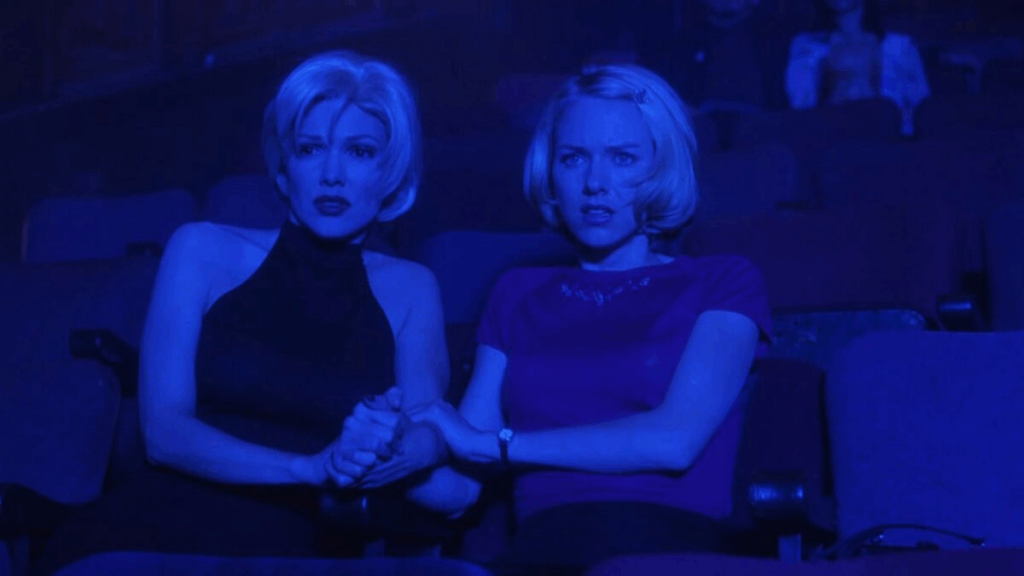
About Diane/Betty and Camilla/Rita
The two women at the center, Diane and Camilla, seem like afterimages of a cultural duplication: two figures, two ideals, two ways in which femininity is socially exploited. And their names – Dianne, Camilla – inevitably evoke another drama: Lady Diana and Camilla Parker-Bowles. There, too: the victim, the idol, the martyr of the media public and the conformist, the survivor, the one who remains. It’s as if culture recognizes only two forms in which women are allowed to be visible: as sufferers or as participants.
I also always feel like Mulholland Drive is about a love that can only exist as long as it remains unspoken. As soon as it’s given a name („Diane,“ „Camilla“) it begins to disintegrate. Perhaps because these names come from a system that doesn’t intend love for two women.
In this reading, Mulholland Drive is a film about its structural impossibility. About an order that views female desire not as a force, but as a defect. About the way a system internalizes its dream logic: the promise of freedom that becomes a trap; the promise of visibility that ends in alienation.
When Diane looks at Camilla, she’s not just looking at a lover, but at a symbol: at what she herself is never allowed to be. Camilla is the kind of woman patriarchy rewards: supple, available, radiant in the right pose. Diane, on the other hand, is the one who still believes there’s something behind the pose: a truth, an authenticity, a love that isn’t fake.
But that’s precisely her tragedy.
Because in Hollywood and perhaps in all of capitalist culture everything is a pose. Even desire. Even pain.
Lynch shows how desire behaves under the conditions of the commodity: it wants to possess, but not to connect. And so the relationship between the two women becomes an allegory-like study in alienation: Camilla performs femininity as currency, Diane internalizes it as guilt.
A paradoxical tension arises between the two: the desire to become one and the impossibility of accomplishing it. Many people interpret, that Diane doesn’t want to possess Camilla, but to become her. Or: Both want to become each other which is why Rita starts to wear the wig. It don’t interpret this as literally. To me it reflects the longing for them to lose themselves into each other, to transcend the boundaries of the role. A desire for fusion that is profoundly lesbian. Not in the sense of sexuality, but in the sense of feminine writing: the longing to speak another language in which subject and object are not mutually exclusive.
________________________________________________________________
Fragmentation of Female Identity: DID

This dynamic is inseparable from the film’s broader engagement with the fragmentation of female identity. Diane and Camilla can be read as two sides of a single subject, divided by social and ideological constraints, a psychological duality that resonates strongly with the phenomenology of Dissociative Identity Disorder (DID). The shifting identities, fluid names, and dreamlike alternations of presence and absence in the narrative echo the ways in which trauma and systemic constraint can produce internal multiplicity: women are compelled to perform multiple selves, often incompatible, simultaneously, as survival strategies within patriarchal structures. It is striking that this connection – to DID, to internalized multiplicity – is rarely made in mainstream or academic readings of the film, despite the narrative and visual cues. The circular apartments, the labyrinthine streets, the doubling of roles, and the seamless transitions between Betty and Diane, Rita and Camilla, all gesture toward a psyche structured by fragmentation, repetition, and external imposition of identity.
In this context, the longing of the two women takes on an additional depth: it is a longing for unity within a split self, for coherence in a system designed to enforce contradiction. The desire to merge, to inhabit the other’s identity, is at once erotic, emotional, and epistemological: it is a negotiation with the self’s own internal divisions, magnified by social and ideological pressures. That such a reading is seldom acknowledged perhaps reflects discomfort with framing female desire and subjectivity in terms of trauma and structural constraint rather than moral narrative, yet it offers one of the most precise interpretive keys to understanding the psychological and social architecture of Mulholland Drive. Diane and Camilla, in their shifting, overlapping selves, become simultaneously the subject and object of their own desires, caught in a labyrinth of visibility, fantasy, and internalized social imperatives.
Even if these points resonate or feel recognizable, I personally resist a reading that over-psychologizes the film, preferring to foreground the material, social, and ideological structures that shape desire and identity alongside the individual psyche. Crucially, the film also does not depict a “sick” subject; it depicts trauma and fragmentation as a social phenomenon, as an intrinsic aspect of female reality, even when unspoken. The splitting of identity and the internalized contradictions are not merely individual pathologies but symptomatic of structural pressures: patriarchal surveillance, economic precarity, and cultural prescriptions of femininity. In this sense, the representation feels more truthful than the multitude of films that explicitly frame psychological conditions yet remain confined to the individual level, abstracted from social context. Diane and Camilla, in their shifting, overlapping selves, embody a collective experience: the negotiation of visibility, desire, and constraint within a world that imposes multiplicity as a necessary condition of female existence.
________________________________________________________________
On the need to forget in order to love
Camilla’s/Rita’s amnesia is one of the core symbols of Mulholland Drive. In the movie it is portrayed as less of a medical than a cultural phenomenon, less a loss of memory than a metaphor for a structural experience of modernity: the fragmentation of the subject under conditions of permanent over-exertion. In the character of Rita, this experience condenses into a specifically female form as a compulsion to forget oneself in order to even exist within a patriarchally coded world.
From a cultural studies perspective, amnesia can be interpreted as an expression of socially induced dissociation. In psychopathology, the term refers to the splitting off of individual contents of consciousness, usually as a reaction to traumatic experiences. In Lynch’s film, this dissociation appears not as an exception, but as the norm. Female subjectivity is presented here as a state of constant division: between desire and adaptation, between visibility and erasure, between self-perception and external definition, between different roles.
In this sense, Rita’s memory loss can be understood as a form of cultural allegory. Patriarchy demands a paradoxical dual structure from women: they are to be simultaneously naive and knowing, innocent and seductive, autonomous and available. The simultaneity of these mutually exclusive demands enforces an identity that necessarily remains unstable. What is referred to as „dissociative“ in diagnostics is not pathological here, but systemicn: a symptom of the social matrix that does not provide for female coherence.
The motif of amnesia thus points to a historical constant of female socialization: womanhood as role play, womanhood as a performative strategy. The film character materializes a cultural constraint that generates a spectrum of incompatible roles from female existence—mother, child, seductress, victim—that cancel each other out, thereby making stability impossible. In this context, the loss of memory is less a deficit than the logical consequence of a social situation in which memory itself represents a threat: Those who remember see through the fiction and thus endanger the system that thrives on it.
If one reads the first part of the film as Dianne’s dream – following the widespread interpretation – Rita’s amnesia takes on an additional layer of meaning. In her dream, Dianne creates a Camilla who has lost her memory. A Camilla who no longer knows anything about hierarchies, careers, men, and power games. A Camilla who is free from all those cultural influences that Dianne experienced as destructive in reality. The amnesia here functions as a projection surface for a utopian wish: the wish for a female relationship uncontaminated by the logic of patriarchy.
But it is precisely in this wish that the tragedy is revealed. To enable an unspoiled, equal relationship, Dianne must symbolically empty the woman she loves. Rob her of her past, her experience, her memory. Love is thus tied to forgetting; tenderness is only possible where memory is suspended. The motif of amnesia thus marks a central paradox: female liberation is conceivable in dreams only as self-erasure.
This dynamic reflects a deeper cultural logic. Patriarchy has consistently marginalized the memory of the feminine: women’s bodies appear in art, religion, and popular culture as a surface, a projection surface for male meaning production. In Lynch’s film, this surface becomes literal: Rita’s identity is empty, she is pure appearance, accessible, malleable, available. Her amnesia makes her the ideal subject of desire. A desire that can only exist as long as there is no counterpart with history, trauma, and willfulness.
________________________________________________________________
Lesbian pain and visibility
Many of my lesbian friends dislike Mulholland Drive. To them, it is too destructive, too dark; they have already witnessed too many tragic lesbian narratives and require neither repetition nor amplification of our pain.
I, however, find in it a peculiar form of recognition and resonance. The film renders lesbian desire visible within a cinematic terrain where such stories are otherwise nearly nonexistent. Within the contours of Lynch’s dreamlike LA, Diane and Camilla’s desire is inscribed, fragile and fleeting, against a landscape structured by male power, male gaze, social hierarchy, and ideological surveillance. There is an almost unbearable intensity in this visibility. Painful, yes, but also authentic: a mirror not of fantasy but of longing, of vulnerability, of the precariousness of love in a world designed to overlook it.
For me, Mulholland Drive articulates a pain that is both personal and structural. It transforms the private ache of minority experience into a cinematic form, giving shape to desires that are too often unacknowledged, fears that are too often invisible. The tragedy is heightened by the medium itself: Hollywood’s gaze, patriarchal and omnipresent, is simultaneously the very lens through which lesbian intimacy is rendered and the force that constrains it. In this sense, the film functions as both a dream and a witness. A dream I might have had as a teenager, a dream that inscribes my marginality onto the screen, reflecting it back with all its melancholy and intensity.
The film’s darkness, its obsession with jealousy, loss, and erasure, is inseparable from its radical visibility. It refuses to sanitize lesbian desire for comfort or consumption; it allows the raw, unmediated ache of longing to emerge, precarious and powerful. In this way, Mulholland Drive becomes a site of both mourning and acknowledgment: a space where pain is legible, where desire can be recognized even amidst devastation, and where the act of seeing itself – a gaze from within the minority experience – affirms that lesbian lives, loves, and heartbreaks exist, insistently and irreducibly, within a culture structured to make them vanish.